The word Deepavali is commonly understood as a row of lamps. Across India, people celebrate this season in different ways. Some remember Lord Rama returning to Ayodhya. Some remember Krishna defeating Narakasura. Many worship Lakshmi, the goddess of fortune. Vaishnava communities also give special attention to the month of Kartika, the month of Damodara, when devotees offer lamps to Krishna and sing the prayer known as Damodarastakam.
These traditions are not all the same story, and we should not force them into one account. Instead, we shall hear the sacred narratives carefully, and see how each offers a lesson in devotion, courage, humility, mercy, and love. Our principal guide will be the Srimad-Bhagavatam, a revered Purana especially cherished by Gaudiya Vaishnavas. We shall also remember the Ramayana and the teachings preserved by the Vaishnava acharyas. When a festival custom comes from later tradition rather than from the central narrative of a scripture, we will say so.
A flame is small, yet it pushes back darkness. In the same way, one sincere thought of the Lord can bring warmth into a heart that has become worried or restless.
In the Eighth Canto of the Srimad-Bhagavatam, we hear of a time when the demigods had lost their strength and authority. They approached Lord Vishnu, who guided them in a plan that required cooperation with their rivals, the asuras: they would churn the ocean of milk to obtain nectar. Mount Mandara became the churning rod, and the serpent Vasuki served as the rope. Yet the mountain began to sink into the ocean. The Lord then appeared as Kurma, the great tortoise, and supported the mountain on His back.
As the ocean was churned, many wonders appeared. A dangerous poison emerged, threatening all beings, and Lord Shiva accepted it to protect the worlds. Other treasures followed, and then the goddess of fortune, Lakshmi, appeared. She looked carefully at those assembled. Great power alone did not make someone the perfect shelter. Learning alone did not make someone free from desire. Austerity alone did not mean that anger had been conquered. Lakshmi finally chose Lord Vishnu, the Supreme Lord, as her eternal shelter.
Fortune is not merely coins, ornaments, a comfortable house, or success. In the Vaishnava understanding, real auspiciousness is fortune connected with the service of the Lord. Wealth can be used selfishly, or it can be used to feed the hungry, care for guests, support sacred learning, and serve the devotees. When a lamp is offered to Lakshmi-Narayana, a Vaishnava prays not simply, "Give me more," but, "Please let whatever comes into my life become an offering of service."
Dhanvantari, associated with divine healing, also appears during the churning carrying a pot of nectar. In later festival calendars, Dhanteras is associated with health and prosperity — a festival association we should distinguish from the Bhagavatam's larger account.
Bali was a powerful king, the grandson of Prahlada Maharaja. He conquered the heavenly planets, and the Lord appeared as Vamana, a small brahmana boy, at Bali's sacrifice. Bali welcomed Him and offered whatever He requested. The Lord asked for only three steps of land, measured by His own feet. Bali's teacher, Shukracharya, recognised that this visitor was Vishnu and warned that the request could cost him everything. Bali chose generosity and truthfulness.
Then Vamana expanded into the universal form of Trivikrama. With one step He covered the earth, and with the next the heavens. Nothing remained for the third step. Bali, who had lost his kingdom, offered his own head as the place for the third step. His external possessions were taken, but his devotion became unmistakable. The Lord blessed Bali, arranged for him to reside in Sutala, and gave him His special protection. Bali was great not because he controlled many worlds, but because he was willing to surrender before the Supreme Lord.
In some regional traditions, Bali Pratipada is connected with Bali's annual visit to his people. That detail belongs to festival tradition and is not the central event narrated in the Bhagavatam.
In the Tenth Canto, chapter fifty-nine, the Srimad-Bhagavatam tells of Krishna's defeat of Naraka, also called Bhaumasura. This story is associated in many traditions with Naraka Chaturdashi, the day before the main Diwali night. Naraka had become cruel and arrogant. He stole the earrings of Aditi, mother of the demigods, and captured many young women, holding them against their will.
Krishna mounted Garuda and went with His wife Satyabhama to the fortified city of Pragjyotishapura. He broke through its barriers of mountains, weapons, water, fire and wind, defeated the demon Mura, and finally Naraka himself. Bhumi, the Earth goddess and Naraka's mother, returned the stolen earrings and prayed for the protection of Naraka's son, and Krishna granted her request. He also freed the captive women and accepted them with compassion and honour. The Lord did not blame the captives for the suffering inflicted upon them. He gave them protection and a future.
Krishna does not fight because He enjoys hurting others. He acts to stop oppression and protect those who cannot protect themselves. Strength becomes divine when it is joined to compassion and justice.
The Ramayana tells how Rama went into forest exile for fourteen years because of a promise made by His father, King Dasharatha, accompanied by Sita and Lakshmana. Ravana abducted Sita and took her to Lanka. Rama formed an alliance with Sugriva and the vanara heroes, among whom Hanuman became the shining example of courage and devotion. After a great struggle, Ravana was defeated and Sita was recovered.
Bharata, Rama's younger brother, had not treated the kingdom as his own. He placed Rama's sandals on the throne and governed as a servant, waiting for the rightful king to return — a remarkable picture of responsibility without possessiveness. The closing portion of the Yuddha Kanda describes Rama's return to Ayodhya and His consecration. Later tradition especially associates the homecoming with lamps lighting the city: the return is in the Ramayana; the familiar picture of rows of lamps is a celebrated festival tradition associated with that return.
Rama's return is more than the homecoming of a prince. It is the restoration of dharma, the right ordering of life through truth, responsibility, compassion, and service. In Gaudiya Vaishnava understanding, Rama is worshipped as the Supreme Lord, and the lamps of the homecoming remind devotees that the return of the Lord brings joy to hearts that have waited for Him.
Now we come to a pastime especially dear to Gaudiya Vaishnavas during Kartika, narrated in the ninth chapter of the Tenth Canto. In Gokula, Mother Yashoda was churning yogurt and singing about Krishna's childhood activities. Little Krishna came to her, hungry, and she began to feed Him. Then she noticed the milk on the stove boiling over, put Him down and hurried to save it. Displeased, Krishna broke a pot of yogurt and began eating butter.
Yashoda chased Him, her hair loosening and her flowers falling, until Krishna allowed Himself to be caught. She wanted to tie Him to a wooden mortar, but the rope was always two fingers too short. She added another rope, and then another, yet it remained too short. At last, seeing His mother's effort and affection, Krishna allowed Himself to be bound. The name Damodara refers to the Lord whose belly was bound by a rope. The Bhagavatam explains that the Lord is conquered not by force, but by the love of His devotees.
Gaudiya teachers often explain the two fingers as representing the devotee's sincere endeavour and the Lord's mercy. That is a devotional interpretation, not a separate event in the story itself: Yashoda made her effort, and Krishna gave His grace.
The pastime continues in the next chapter. Still tied to the mortar, Krishna crawled between two tall arjuna trees — Nalakuvara and Manigriva, sons of Kuvera, whom Narada had cursed for their pride, with the promise that they would one day see Krishna. The mortar caught between the trunks, and the trees fell with a mighty crash. Two radiant beings emerged, acknowledged their former arrogance, and received Krishna's blessing. They had been corrected, but they had not been abandoned.
The lifting of Govardhana Hill is described in the Tenth Canto, chapters twenty-four through twenty-seven. The cowherd community of Vrindavan was preparing worship for Indra, who is associated with rain. Krishna encouraged them instead to honour the things that sustained their life of service: the cows, the brahmanas, the pastures, and Govardhana Hill. Indra became angry and sent destructive rain clouds against Vrindavan.
Krishna lifted Govardhana Hill with the little finger of His left hand and invited the people, their families, and their cows to come beneath it. For seven days and nights the hill served as a vast shelter. Indra eventually understood that his pride had led him to act wrongly, stopped the storm, and later approached Krishna with humility, honouring Him as Govinda. Indra had a position of authority, but he forgot that authority is not ownership.
Govardhana Puja, also called Annakuta, is celebrated on the day after Diwali in many communities. Devotees prepare offerings of many foods, arranging them like a mountain before the Lord — an expression of gratitude, abundance shared in worship, and the wish to place everything in divine service.
For Gaudiya Vaishnavas, Kartika is especially associated with Damodara-lila. The Hari-bhakti-vilasa, a major work on Vaishnava devotional practice associated with Gopala Bhatta Goswami, gathers teachings about observing Kartika and offering lamps to Lord Hari. These teachings praise a small offering made with devotion. The lamp is an act of love, not a machine that purchases a reward.
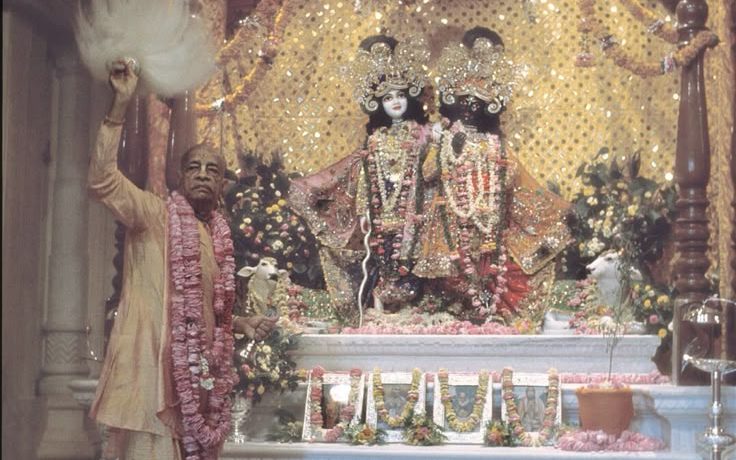
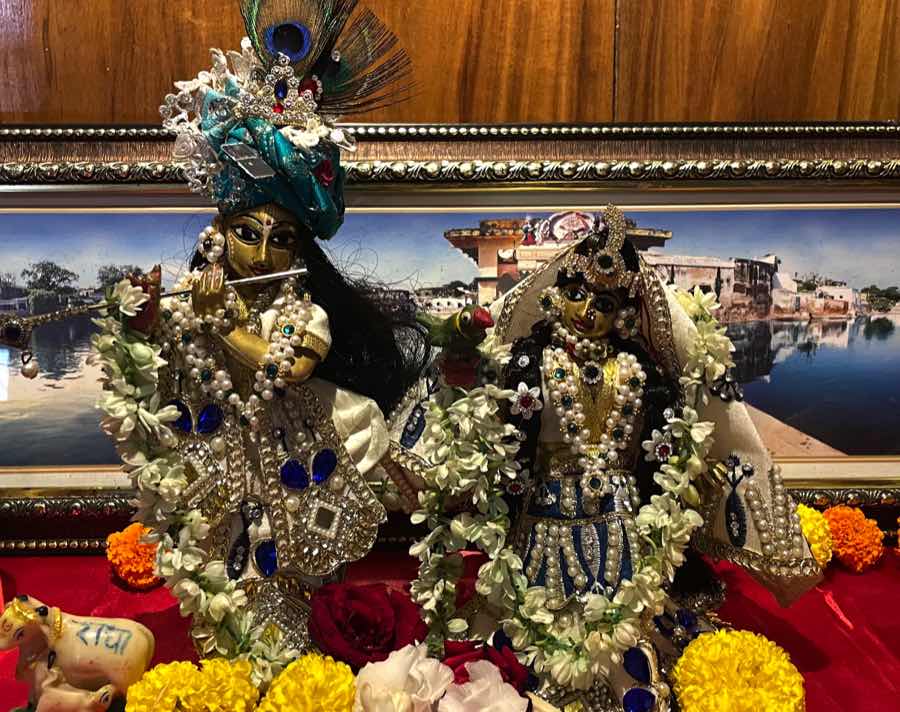
Each evening, a devotee may offer a lamp before the deity and sing Damodarastakam, which remembers Krishna standing with a rope around His belly, His eyes filled with tears, and His face marked by the fear He shows before Mother Yashoda. A lamp is made of ordinary things: a wick, oil or ghee, a small vessel, and a flame. Yet offered with devotion, it says, "My Lord, I remember You. Please let my life become useful in Your service."
If a real flame is used, it should be placed safely away from curtains, bedding, children, and anything that can catch fire, and should never be left unattended. Devotion and care belong together.
The outer flame will eventually go out. The heart's practice can continue. When you are kind to a friend, when you tell the truth even though it is difficult, when you help someone without demanding praise, when you remember Krishna before sleep, you are carrying something of the lamp into daily life.
These stories come from different texts, traditions, and festival customs. We have not forced them to become one historical event. Their shared light is devotional: the Lord protects, guides, accepts loving service, and invites us to become more truthful, humble, and compassionate.
"My dear Krishna, thank You for this day. Please help me remember You. Please help me be kind to my family and friends. Please protect all living beings, and please let my heart become a place where Your name is welcomed."
Hare Krishna, Hare Krishna, Krishna Krishna, Hare Hare
Hare Rama, Hare Rama, Rama Rama, Hare Hare
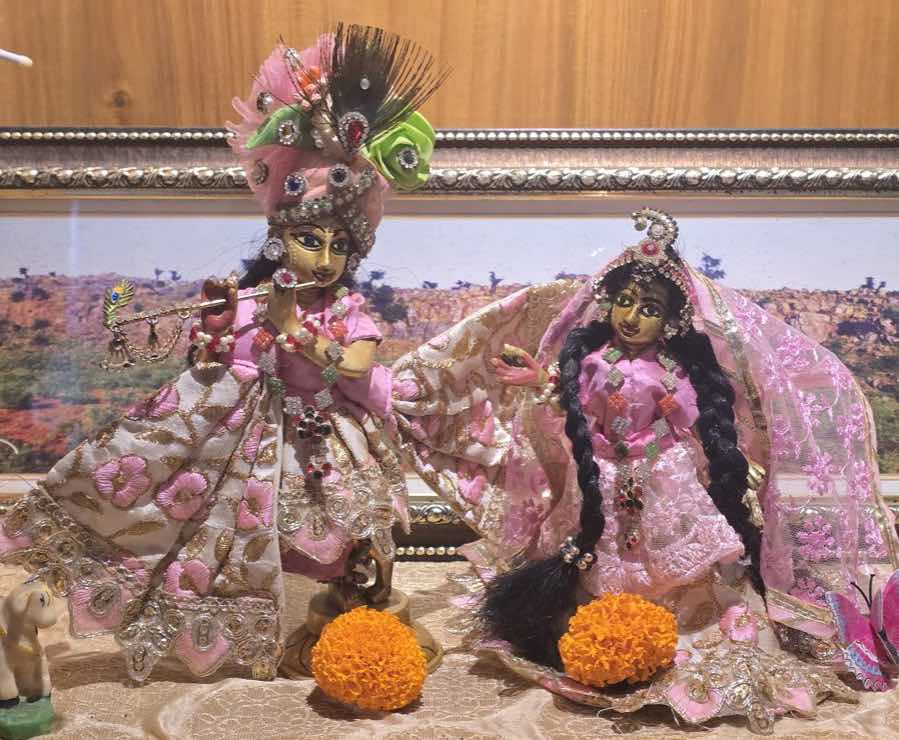
May Sri Sri Radha-Damodara bless you with remembrance and a peaceful heart. May the mercy of Sri Guru and the Vaishnavas guide you.
Sources: Srimad-Bhagavatam 8.6–8.9 (the churning of the milk ocean), 8.15–8.23 (Bali Maharaja and Vamanadeva), 10.9–10.10 (Damodara-lila and the arjuna trees), 10.24–10.27 (Govardhana) and 10.59 (Narakasura); Valmiki Ramayana, Yuddha Kanda; Hari-bhakti-vilasa, Vilasa 16 (Kartika and the offering of lamps). This is a devotional retelling, not a verbatim translation of scripture.