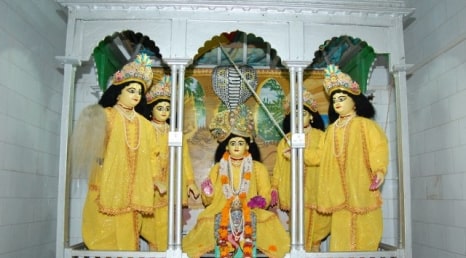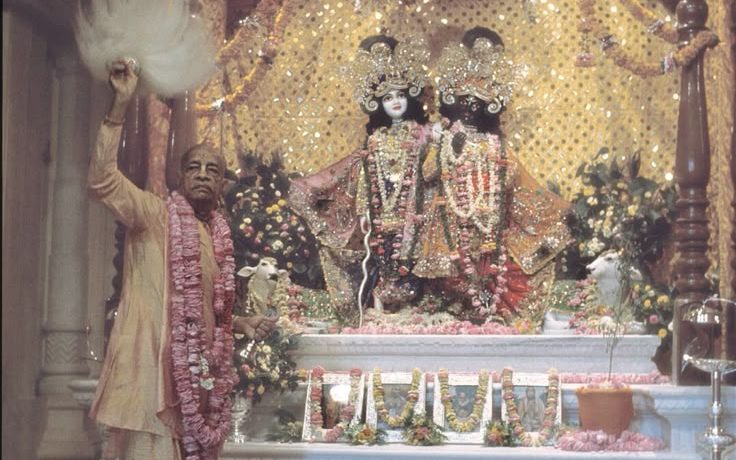
Śrī Balarāma Jayantī is the appearance day of Śrī Baladeva Prabhu, the elder brother of Śrī Kṛṣṇa and the original manifestation of the guru-tattva.
Balarāma is the first expansion of Śrī Kṛṣṇa. He is Kṛṣṇa's eternal companion, His elder brother in Vraja, and the source of spiritual strength for those who sincerely desire to approach Kṛṣṇa.
When we hear the pastimes of Balarāma, we should therefore not think only of His enormous physical strength. His real strength is spiritual strength—the strength that enables a sincere soul to progress in bhakti.
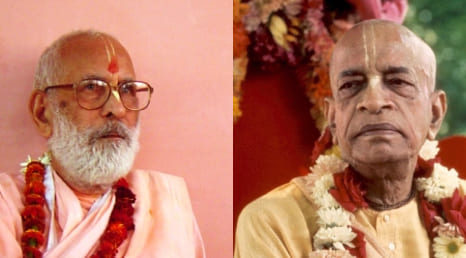
Śrīla Bhaktivedānta Nārāyaṇa Gosvāmī Mahārāja repeatedly emphasized this point. Balarāma is guru-tattva, the complete principle of the spiritual master. The bona fide guru, appearing in the disciplic succession, gives the soul the strength necessary to approach Śrī Kṛṣṇa.
Therefore, Balarāma Jayantī is not simply a festival commemorating the birth of a powerful personality. It is a day to pray:
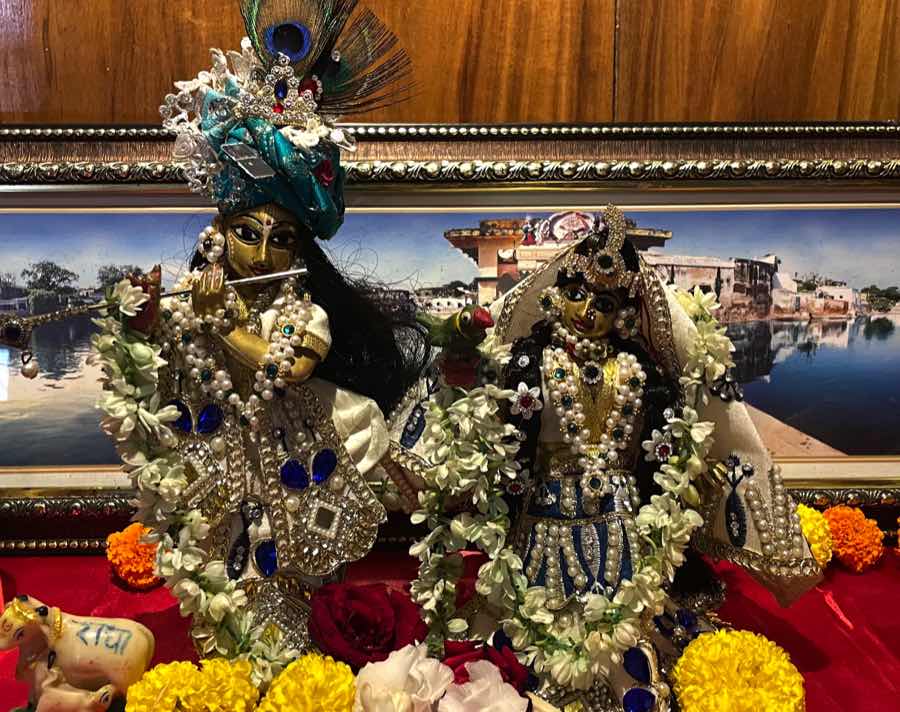
"O Baladeva Prabhu, please give me the strength to follow the path of bhakti. Please remove the obstacles in my heart and allow me to serve Śrī Śrī Rādhā-Kṛṣṇa under the guidance of guru and Vaiṣṇavas."
Balarāma's appearance is intimately connected with the appearance of Śrī Kṛṣṇa.
The Śrīmad-Bhāgavatam describes how the Lord's plenary expansion was transferred from the womb of Devakī to that of Rohiṇī by the internal potency of the Lord, Yogamāyā.
Thus Balarāma appeared in Vraja as the son of Rohiṇī, while remaining eternally the first expansion of Śrī Kṛṣṇa.
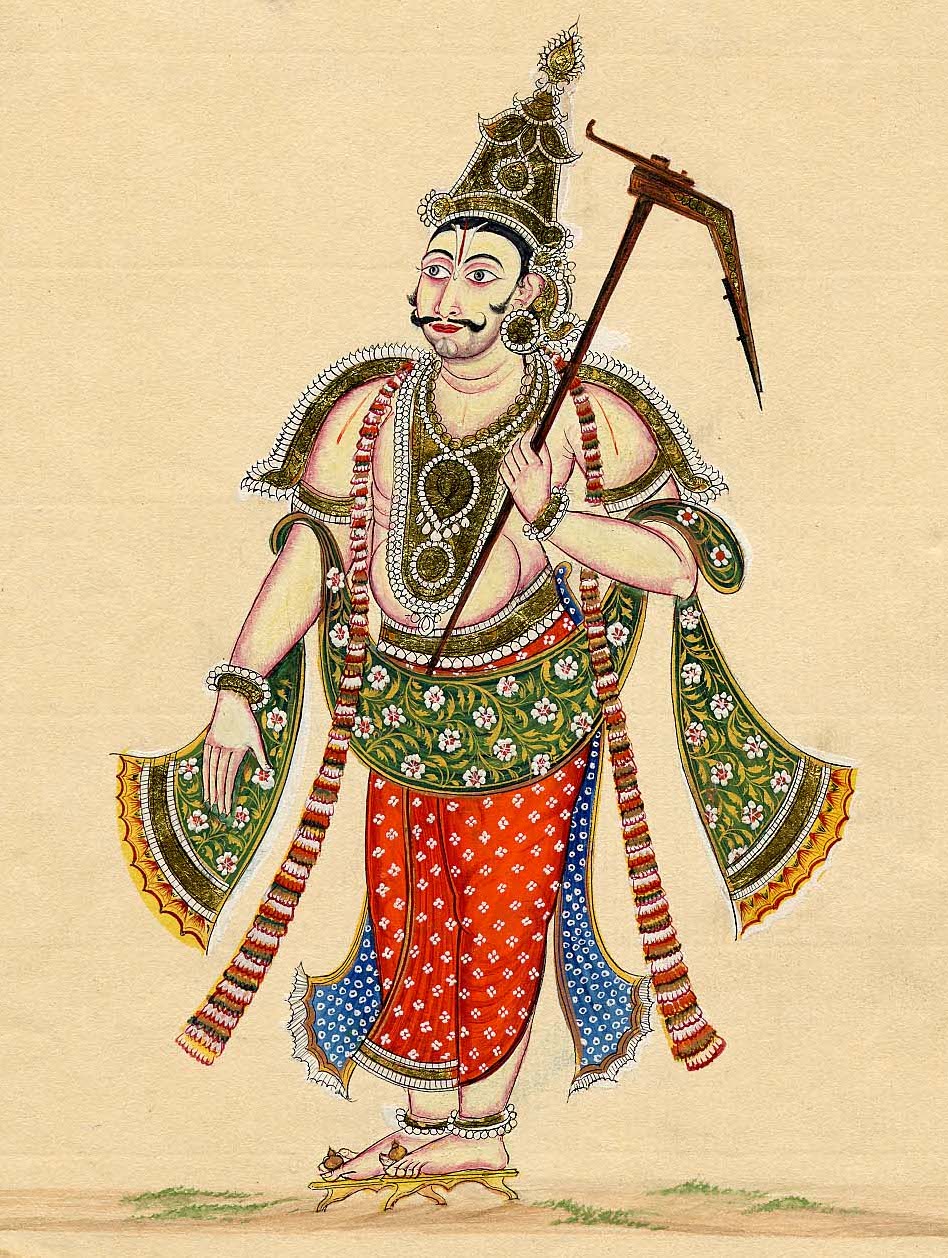
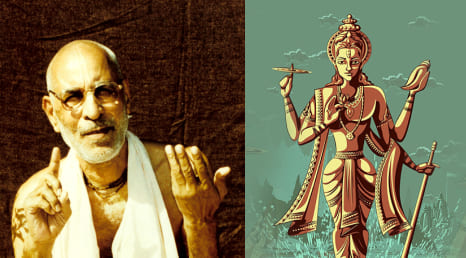
Śrī Baladeva Prabhu bearing His plough (hala). Painting, c. 1820. Public domain. Garga Muni later explained His different names: Rāma, Baladeva and Saṅkarṣaṇa. The name Balarāma reminds us of His spiritual strength. But what kind of strength does He give? Not merely the strength to defeat an external enemy.
He gives the strength to defeat the enemies within our own hearts. This is why His Vraja pastimes are so important for the practitioner of bhakti.
Balarāma's entire existence is connected with service to Kṛṣṇa.
He serves Kṛṣṇa as His elder brother, as His friend, as His bed, as His sitting place, as His shoes, as His ornaments, and in innumerable other forms.
Śrīla Bhaktivedānta Nārāyaṇa Gosvāmī Mahārāja explains that Balarāma manifests in different forms to serve Kṛṣṇa in His various incarnations. In Rāma-līlā He appears as Lakṣmaṇa, and in Gaura-līlā He appears as Nityānanda Prabhu.
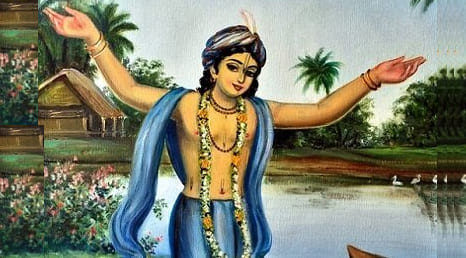
Śrī Nityānanda Prabhu — Balarāma in Gaura-līlā. This gives us an essential lesson. The perfection of strength is service.
Balarāma possesses unlimited strength, yet His strength is never independent of Kṛṣṇa. His strength exists for Kṛṣṇa's pleasure and for serving Kṛṣṇa's devotees.
One of the most beautiful Balarāma pastimes took place in Tālavana.
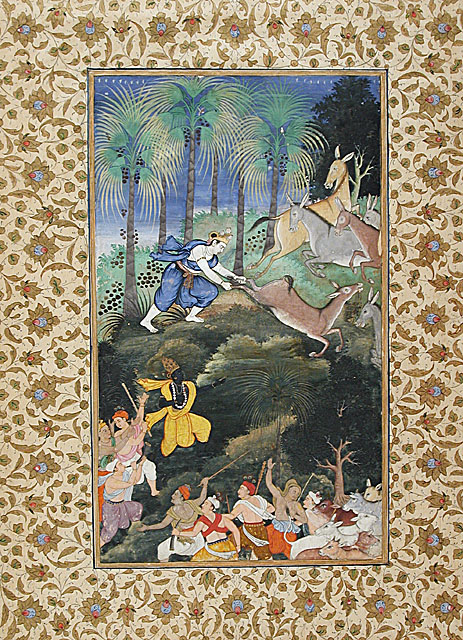
Balarāma seizes Dhenukāsura by his hind legs and hurls him into the palm trees of Tālavana. Folio from a Harivaṁśa manuscript, attributed to Basawan, c. 1585–1590. Public domain.
Tālavana was filled with wonderful palm trees and delicious fruits. Yet nobody could enjoy those fruits because the forest was controlled by a terrible demon named Dhenukāsura, who had assumed the form of a donkey.
The cowherd boys wanted to enter the forest and enjoy the fruits, but Dhenukāsura and his associates prevented everyone from entering.
Balarāma entered Tālavana. He shook one of the palm trees, causing the fruits to fall. The noise attracted Dhenukāsura. The demon charged at Balarāma and attempted to attack Him with his powerful hind legs.
Balarāma caught the demon by his hind legs, whirled him around and threw him into the trees. Dhenukāsura and his associates were defeated, and Tālavana was freed from their control.
The Śrīmad-Bhāgavatam describes this pastime in the Fifteenth Chapter of the Tenth Canto. But why did Balarāma perform this pastime? What does it teach us? Śrīla Bhaktivedānta Nārāyaṇa Gosvāmī Mahārāja explains that Dhenukāsura represents ignorance. A donkey carries a heavy load but does not understand the value of what it carries.
Similarly, a person may collect enormous amounts of material knowledge, possessions and information, yet remain spiritually ignorant.
The deeper problem is not lack of information. It is lack of proper understanding of our relationship with Kṛṣṇa. Dhenukāsura was guarding the fruits of Tālavana. He would not enjoy them properly himself, and he would not allow others to enjoy them either. In the same way, ignorance can stand between the soul and the sweetness of devotional service. Therefore, we pray to Balarāma: "Please remove the Dhenukāsura within my heart."
Let us not remain like a donkey—carrying the burden of material knowledge and possessions while failing to understand the real purpose of human life.
The Garga Saṁhitā gives an additional account of Dhenukāsura's previous birth. It identifies him as Sāhasika, the son of Bali Mahārāja. Sāhasika once disturbed the meditation of the great sage Durvāsā Muni and received a curse to become an ass.
Yet the curse ultimately became a blessing, because the same account explains that he would attain liberation through the hands of Śrī Balarāma.
Thus the Garga Saṁhitā calls this pastime the liberation of Dhenukāsura. This is an important way to understand the Lord's dealings with the demons. Balarāma did not simply destroy Dhenukāsura. Through His association, the demon's demonic existence came to an end and his ultimate spiritual benefit was achieved.
Another extremely important Balarāma pastime is His killing of Pralambāsura.
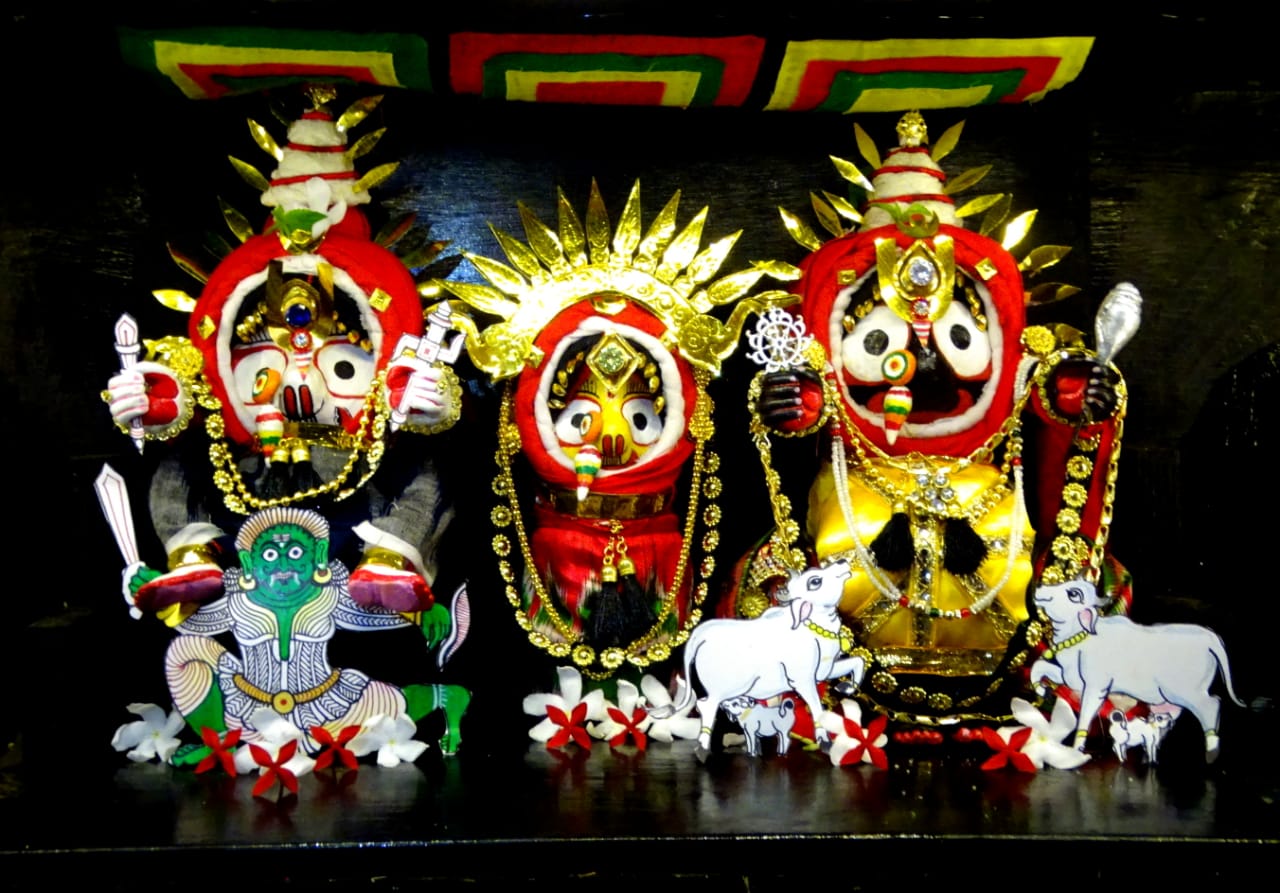
Pralambāsura Badha Beśa — Śrī Balabhadra shown with the slain Pralamba at His feet, Jagannātha temple. Photo: Swastik Kumar Baral, CC BY-SA 4.0.
Pralambāsura came to Vraja disguised as a cowherd boy. He appeared to be one of Kṛṣṇa and Balarāma's friends, but internally he had a completely different intention. He wanted to kill Balarāma. Kṛṣṇa knew the demon's real identity but allowed the pastime to proceed.
The cowherd boys began playing together. They divided themselves into teams, and according to the rules of the game, the defeated boys had to carry the victorious boys.
Pralambāsura arranged to carry Balarāma. He began taking Balarāma away from the others. But Balarāma understood what was happening. The demon revealed his enormous form, but Balarāma became extremely heavy. Pralamba could no longer carry Him. Then Balarāma struck him with His fist. The demon fell dead. The cowherd boys rejoiced, and the demigods showered flowers. The Śrīmad-Bhāgavatam describes this wonderful pastime in the Eighteenth Chapter of the Tenth Canto.
This pastime carries a particularly serious lesson for those practising bhakti. Pralambāsura looked like a devotee. He dressed like the cowherd boys. He played with them. He behaved externally like their friend. But internally he wanted to harm them. This is the danger of duplicity.
Śrīla Bhaktivedānta Nārāyaṇa Gosvāmī Mahārāja explains that Pralambāsura represents kapaṭatā—duplicity or hypocrisy. He specifically explains the pastime as showing how guru-tattva removes this duplicity from the disciple.
This is a profound teaching. We may deceive other people. We may even convince other people that we are advanced devotees. But we cannot deceive Balarāma. He knows what is actually within the heart. Therefore, real bhakti requires simplicity and honesty. We should not try to appear more advanced than we actually are. Instead, we should sincerely pray:
"O Baladeva Prabhu, please remove the Pralambāsura within me—the tendency to pretend, deceive, manipulate or hide my real motives."
These two pastimes can therefore be contemplated together.
Dhenukāsura represents the darkness of ignorance and the mentality that prevents us from properly understanding the value of spiritual life.
Pralambāsura represents hypocrisy and hidden motives—the tendency to appear spiritual externally while maintaining material desires internally.
Both are destroyed by Balarāma. This gives us a beautiful progression: First, Balarāma removes ignorance. Then He removes duplicity. Then He gives us spiritual strength to serve Kṛṣṇa.
Balarāma's Vraja pastimes include many other wonderful manifestations of His strength and protection.
When Kṛṣṇa and Balarāma came to Mathurā, Kaṁsa arranged for Them to fight his powerful wrestlers. Balarāma fought Muṣṭika, one of Kaṁsa's strongest wrestlers, and defeated him.
This pastime demonstrates Balarāma's extraordinary physical strength, but again, His strength is always engaged in the service of Kṛṣṇa and the protection of devotees.
Later in His pastimes, Balarāma killed Dvivida, a powerful gorilla who created havoc and had offended Balarāma in connection with His previous incarnation as Lakṣmaṇa.
Śrīla Nārāyaṇa Gosvāmī Mahārāja also connects Dvivida with an offence toward Lakṣmaṇa and explains that Balarāma destroyed him.
Balarāma also demonstrated His position as Jagad-guru, the spiritual master of the universe, at Naimiṣāraṇya.
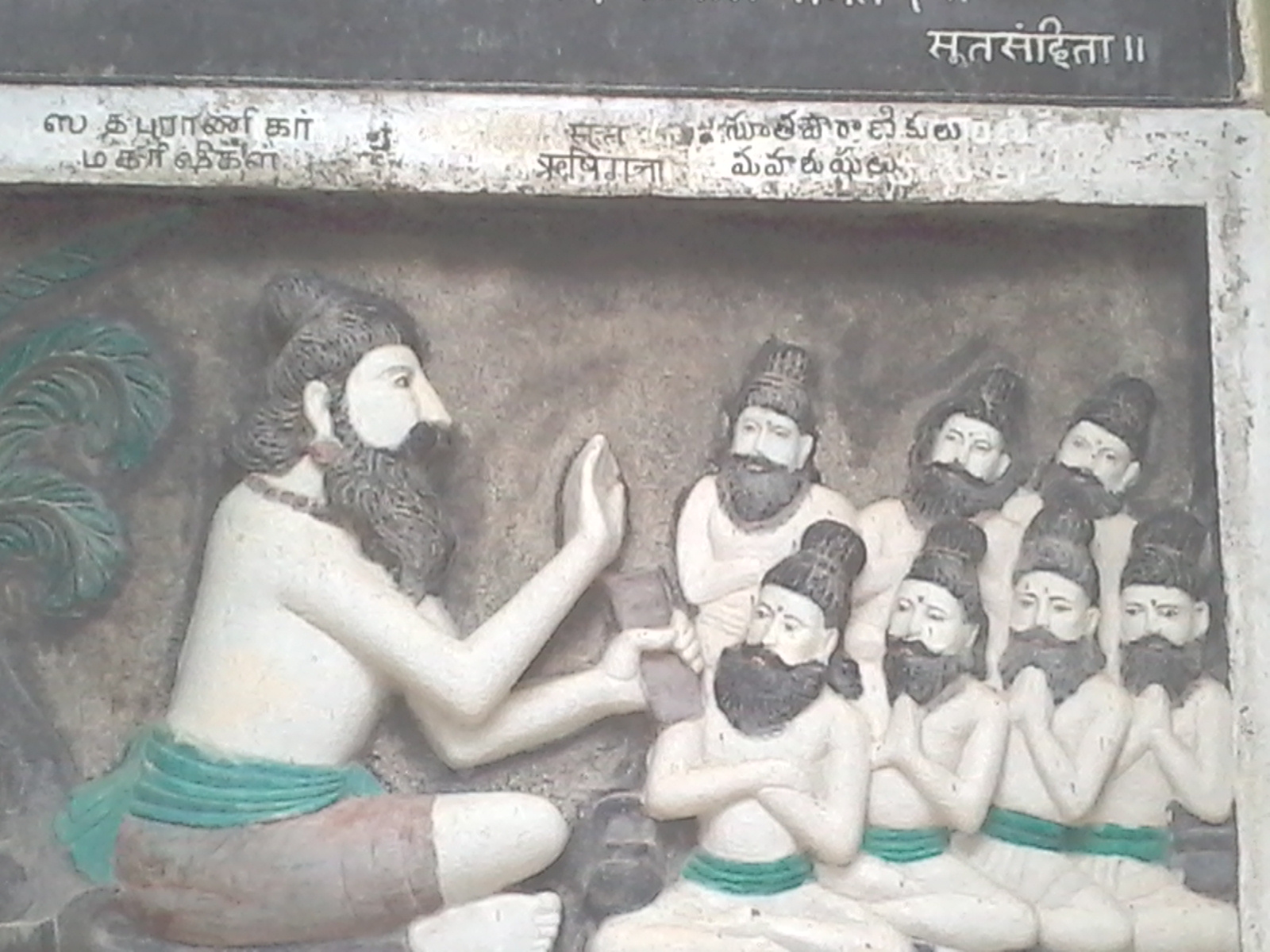
A Sūta reciting the Purāṇas to the assembled sages at Naimiṣāraṇya, the setting of this pastime. Temple relief; photo: S. P. Krishnamurthi, CC BY-SA 3.0.
Romaharṣaṇa Sūta was sitting on the assembly's elevated seat while Balarāma entered. Everyone else stood up to offer respect to Balarāma, but Romaharṣaṇa did not rise. Balarāma considered him unqualified to remain in the position of speaker because he had failed to show proper respect.
This pastime teaches that spiritual knowledge without humility is dangerous. A person may speak beautifully about scripture, but if genuine Vaiṣṇava humility is absent, something essential is missing. Śrīla Nārāyaṇa Gosvāmī Mahārāja explains this pastime in relation to Balarāma's position as Jagad-guru.
This is perhaps the most important teaching for us. Balarāma is not merely a heroic figure from Kṛṣṇa's childhood. He is akhanda-guru-tattva—the undivided principle of the spiritual master. The bona fide guru appears as the representative and servant of this principle.
Śrīla Bhaktivedānta Nārāyaṇa Gosvāmī Mahārāja explains that Balarāma or Nityānanda Prabhu is the original spiritual master, and the bona fide guru in the disciplic succession represents this mercy.
Therefore, if we genuinely want to approach Rādhā and Kṛṣṇa, we cannot bypass guru-tattva. We need Balarāma's mercy. We need the mercy of guru. We need the association of Vaiṣṇavas. And we need the strength to follow their instructions.
On this auspicious day, rather than asking only for material strength, we can ask Balarāma for spiritual strength. We can pray: "Please remove my ignorance, like Dhenukāsura." "Please remove my duplicity, like Pralambāsura." "Please remove my pride, like the pride demonstrated by Romaharṣaṇa."
"Please give me the strength to sincerely follow guru and Vaiṣṇavas." "Please give me strength to serve Śrī Kṛṣṇa." This is the real gift of Balarāma.
The pastimes of Balarāma show us that the Lord's strength is always used for a higher purpose. He protects Kṛṣṇa's devotees. He removes obstacles. He destroys ignorance. He exposes duplicity. He protects the path of bhakti. And He gives the sincere practitioner the strength to move forward. When we feel weak in our spiritual practice, we should remember Balarāma.
When we recognise ignorance in our heart, we should remember Dhenukāsura. When we discover hidden motives or hypocrisy within ourselves, we should remember Pralambāsura. And when we need the strength to surrender to the guidance of a bona fide guru, we should remember that Balarāma is guru-tattva. May we therefore pray on this sacred Balarāma Jayantī:
"O Śrī Baladeva Prabhu, please make my heart simple. Please remove my ignorance and duplicity. Please give me the strength to serve Śrī Guru and the Vaiṣṇavas, and through their mercy, to serve Śrī Śrī Rādhā-Kṛṣṇa."
Śrī Balarāma Jayantī ki jaya! Śrī Baladeva Prabhu ki jaya! Śrī Kṛṣṇa-Balarāma ki jaya! Śrī Guru-paramparā ki jaya! Śrīla Bhaktivedānta Nārāyaṇa Gosvāmī Mahārāja ki jaya! Śrī Rūpānuga Vaiṣṇavas ki jaya!